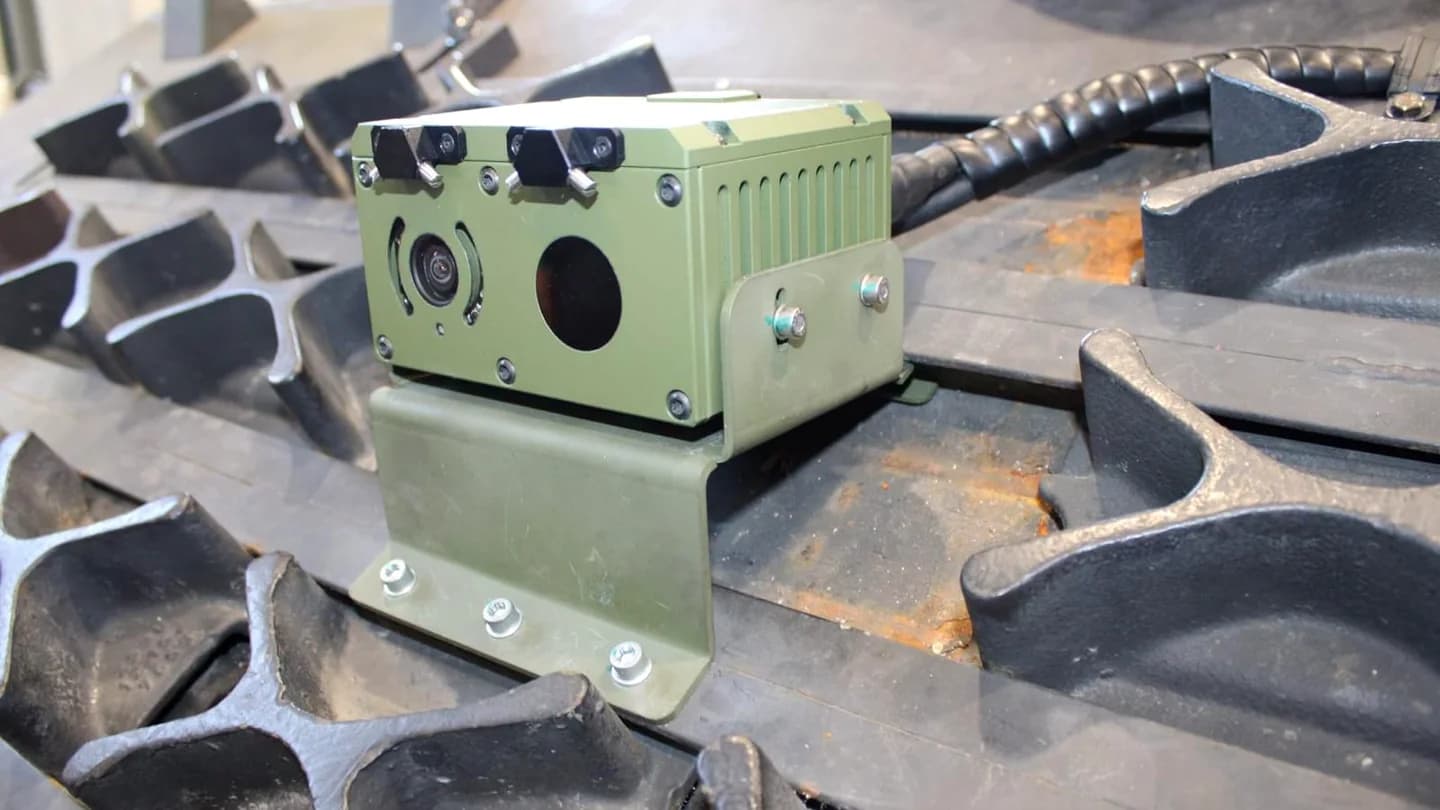
System purpose
ATRI TINDS DVE is a thermal vision system that supports the driver during movement in darkness and reduced visibility.
The system is intended for integration into vehicle platforms where the standard means of observation do not provide the required view under operating conditions.
ATRI manufactures TINDS. OTU works on integrating driver vision systems into vehicle platforms, taking account of vehicle geometry, mounting points, power supply, video channels and conditions of use.
Technology basis
The primary viewing channel may use LWIR (long-wave infrared). Its thermal channel forms an image without illuminating the surrounding area with headlights or active infrared light.
Depending on the configuration, TINDS may include:
- a forward thermal camera;
- additional video or thermal cameras;
- a driver display;
- a video processing and distribution unit;
- controls;
- cabling and mounting components.
Additional video cameras may use their own illumination. The passive thermal channel therefore does not mean that every possible TINDS configuration is entirely passive.
Platform integration
Configuration depends on vehicle construction, required viewing zones, the driver's workstation and how the components interact.
OTU's integration process may include:
- Platform audit.
- Defining the configuration with the manufacturer and customer.
- Integration design.
- Preparing mounting points, cable routes and video interfaces.
- Installation, configuration and checks within the agreed scope.
- Subsequent technical support under the terms of the specific project.
Place in OTU architecture
ATRI TINDS belongs to the DVE (Driver Vision Enhancement) direction.
It combines sensor channels, video processing, display and platform interfaces. Mechanical and electrical adaptation is determined for the specific vehicle rather than a universal configuration for all carriers.
Related solution: Driver Vision Enhancement for Armored Platforms.
Discuss integration
For an initial assessment, specify the platform class, movement conditions, required viewing zones and installation constraints.